MX-QCell
© 2026 Novakuantum. All rights reserved.
A platform program, not the platform itself
MX-QCell is the first application-specific technology program developed through MX. Its role is to turn the platform method into a protected architecture, a measurable experimental program and, if validated, a differentiated technology asset.
The challenge
Fast or weak physical information can be lost before it reaches the measurement chain. MX-QCell asks whether the system can instead be engineered backward from the observable result: define what must survive, identify the interface-owned functions and build the architecture around those requirements.
The solution strategy
The program connects models of bandwidth, observability, charge and transport dynamics, transient response and dynamic admittance with an experimental architecture. Specific material sequences, proprietary geometries and complete device stacks remain confidential.
Value if validated
A successful demonstrator would establish more than one component. It would show that MX can create application-specific systems by linking a critical performance requirement to a designed physical interface and a measurable validation plan. Possible future application paths include advanced sensing, semiconductor interfaces, photonics, cryogenic and quantum systems, and space instrumentation.
Program assets
The current foundation includes a peer-reviewed publication on front-end bandwidth and observability, an Italian patent application filed on 13 January 2026, a European extension strategy in preparation and a second manuscript being refined for submission. Experimental fabrication and prototyping workflows are under development.
Current status — August 2026
MX-QCell is a pre-demonstrator research and development program. A complete demonstrator has not yet produced a validated performance data set. No public claim is made for speed, efficiency, stability, scalability, storage capability or superiority over established technologies.
Validation program
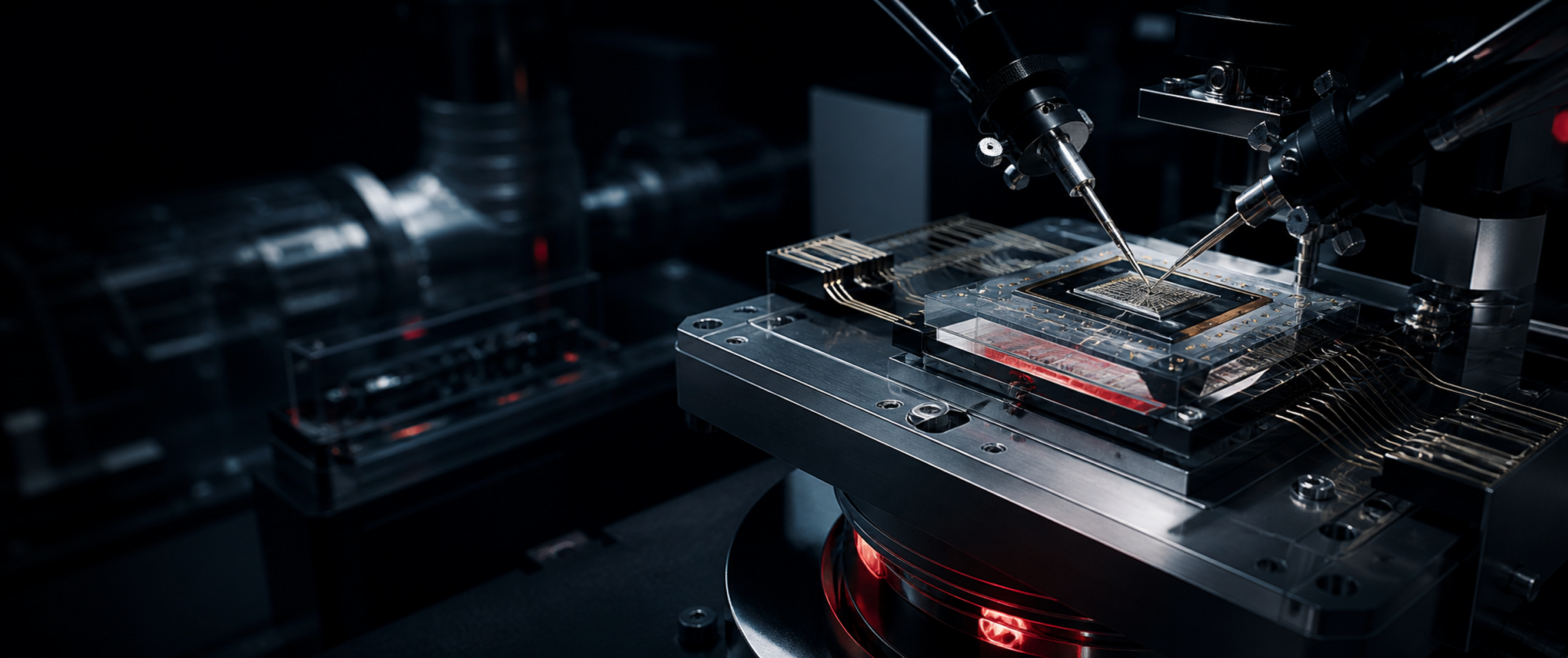
The next sequence is to commission the initial fabrication workflow, produce test and reference structures, measure transport, transient and admittance behaviour, compare the observations with the theoretical framework and select the application path supported by evidence.
Collaboration
MX-QCell provides a focused basis for discussions with scientific and industrial partners interested in experimental validation, application studies, joint development and future technology transfer.
The First Application-Specific Program Built on MX